- tomarrakechdeserttours@gmail.com
- +212702431727

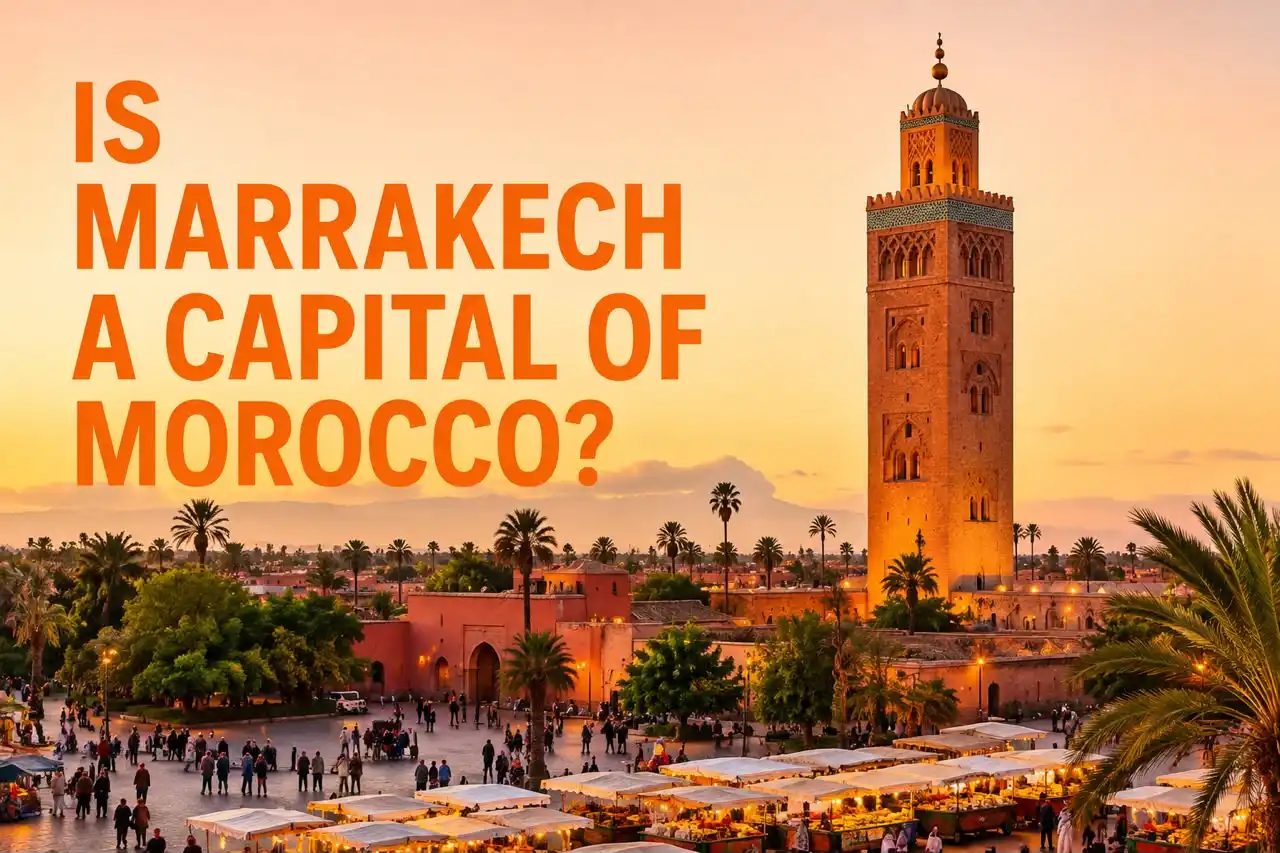
When planning a trip to North Africa, many travelers naturally ask: Is Marrakech the capital of Morocco? With its iconic red sandstone ramparts, bustling Medina, world-famous palaces, and global popularity as Morocco’s top tourist destination, it is easy to see why so many people assume Marrakech holds the official title.
However, the direct answer is no: Marrakech is not the official political capital of Morocco. That title belongs to the coastal city of Rabat, which houses the royal palace, government ministries, and foreign embassies.
While Rabat serves as the political and administrative heart of the kingdom, Marrakech holds a deeply important title of its own. As one of the country’s historic Imperial Cities, Marrakech remains the undisputed cultural and tourism capital of Morocco.
To understand why the question is Marrakech the capital of Morocco comes up so frequently, it helps to look back at the country’s fascinating history. Marrakech was not only a capital in the past, it was the seat of power for several powerful dynasties that shaped the borders and culture of North Africa and southern Europe.
Morocco is famous for its four historic Imperial Cities: Marrakech, Fez, Meknes, and Rabat. Throughout the centuries, ruling dynasties moved the capital depending on their strategic, military, and spiritual priorities.
Marrakech was founded around 1070 AD by Abu Bakr ibn Umar and developed by his cousin Sultan Youssef ibn Tashfin, the great leader of the Almoravid Empire.
The Imperial Seat: Tashfin made Marrakech the official capital of an empire that stretched from West Africa all the way across the Strait of Gibraltar into Andalusia (southern Spain).
Building the Foundations: During this golden era, the city’s iconic subterranean irrigation systems (khettaras) were engineered, thousands of palm trees were planted, and the original red earthen fortification walls were constructed.
When the Almohad Dynasty swept down from the High Atlas Mountains and conquered Marrakech, they kept the city as their imperial capital.
Architectural Marvels: The Almohads transformed Marrakech into a major intellectual and artistic hub. They constructed the world-renowned Koutoubia Mosque, whose minaret inspired both the Giralda in Seville and the Hassan Tower in Rabat.
Global Influence: From Marrakech, the Almohad Caliphs governed an empire spanning North Africa from modern-day Morocco to Tripoli, Libya.
After centuries during which the capital shifted north to Fez under the Marinids, the Saadian Dynasty restored Marrakech as the imperial capital in the 16th century.
The Golden Age: Flush with wealth from sugar trade and sub-Saharan gold routes, Sultan Ahmad al-Mansur built the opulent El Badi Palace (“The Incomparable”) and expanded the stunning Saadian Tombs.
Global Diplomacy: European ambassadors, merchant traders, and scholars flocked to Marrakech, solidifying its international reputation as the power center of the kingdom.
Because Marrakech served as the seat of royal authority for so many centuries, giving Morocco its very name in many languages (derived from Marrakesh), it remains deeply burned into global consciousness as the heart of the nation.
Although many travelers naturally assume Marrakech is the seat of government, Morocco divides its national prominence between two incredible cities. Understanding the distinct roles of Rabat and Marrakech reveals how modern administration and ancient heritage coexist in the kingdom.
Seat of Government: Rabat houses the Parliament, national government ministries, and the supreme court of Morocco.
Royal Residence: The primary official residence of King Mohammed VI, the Dâr-al-Makhzen royal palace, is located in the heart of Rabat.
Diplomatic Hub: All foreign embassies, international consulates, and international diplomatic headquarters are stationed in Rabat.
Modern Stability: French protectorate officials designated Rabat as the capital in 1912 due to its strategic coastal location, a status retained upon independence in 1956.
Gateway for Tourism: Marrakech welcomes millions of international travelers each year, serving as the primary hub for desert excursions and Atlas Mountain tours.
Unrivaled Heritage: Home to UNESCO World Heritage sites including the Jemaa el-Fnaa square, ancient palaces, and centuries-old Medina souks.
Artistic and Culinary Epicenter: The city leads the nation in traditional gastronomy, artisan craftsmanship, luxury riad hospitality, and contemporary African art.
Global Name Recognition: Marrakech is so famous worldwide that the very name of the country, “Morocco,” was derived directly from the name Marrakesh.
To fully grasp why so many travelers wonder if Marrakech is the capital of Morocco, it helps to look at the country’s famous Imperial Cities. Over the centuries, different dynasties chose four distinct cities as their royal seats of power, leaving each with a unique historic legacy.
Marrakech (The Southern Capital): Founded in 1070 AD by the Almoravids, Marrakech served as the seat of power for the Almoravid, Almohad, and Saadian dynasties. Its dramatic red walls, sprawling markets, and strategic position near the Sahara trade routes made it the economic and military heart of southern Morocco.
Fez (The Spiritual Capital): As the oldest of the imperial cities (founded in 789 AD by Idris I), Fez served as the capital during the Idrissid, Marinid, Wattasid, and Alaouite eras. It remains the undisputed religious, intellectual, and traditional artisan capital of the kingdom.
Meknes (The Ismaili Capital): Designated as the imperial capital in the 17th century by Sultan Moulay Ismail (the famous Alaouite ruler), Meknes was transformed into a grand fortress city filled with massive green-tiled gates, grand palaces, and monumental royal stables.
Rabat (The Modern Capital): Briefly elevated as an imperial stronghold by the Almohads in the 12th century, Rabat was officially chosen as the administrative capital during the French protectorate era in 1912 and retained its status when Morocco gained independence in 1956.
While Rabat handles the political affairs of Morocco and Marrakech drives its tourism, both cities offer drastically different experiences for travelers. Understanding these differences helps you decide how to spend your time depending on the trip you want to experience.
Marrakech is vibrant, fast-paced, and deeply sensory. The city revolves around its historic Medina, where bustling souks, snake charmers in Jemaa el-Fnaa, and traditional riads create an immersive cultural energy. It is the ultimate destination for travelers looking for rich history, luxury hospitality, nightlife, and direct access to Sahara Desert excursions and Atlas Mountain treks.
Rabat offers a calm, coastal, and relaxed contrast to Marrakech. As a modern capital city, it features wide palm-lined boulevards, clean streets, and quiet historic sites like the Kasbah of the Udayas and Hassan Tower. Because it caters more to government business than heavy tourism, Rabat gives travelers a more laid-back, authentic view of everyday modern Moroccan life right along the Atlantic Ocean.
Since both cities play such significant roles in Morocco, one as the political capital and the other as the tourism hub, traveling between Rabat and Marrakech is fast, safe, and convenient. Located approximately 320 kilometers (200 miles) apart, here are the best ways to journey between the two cities.
Taking the train operated by ONCF (Morocco’s national railway company) is by far the most popular and comfortable option for both locals and travelers.
Al Boraq & Express Connection: You can take the high-speed Al Boraq train from Rabat to Casablanca, and then connect smoothly to the direct express train south to Marrakech.
Direct Express Trains: Regular direct trains also run daily between Rabat-Ville / Rabat-Agdal stations and Marrakech Station (Gare de Marrakech).
Travel Duration: The journey takes approximately 3.5 to 4 hours.
Comfort & Amenities: First-class and second-class tickets offer air conditioning, comfortable seating, and spacious luggage racks.
Driving between Rabat and Marrakech gives you full flexibility to stop at coastal towns or scenic rural spots along the way.
The Highway Route (A1 & A3 Expressways): The drive follows well-maintained toll highways (Autoroutes du Maroc) connecting Rabat, Casablanca, and Marrakech.
Travel Duration: The drive takes around 3.5 to 4 hours depending on traffic exiting Rabat and entering Marrakech.
Private Chauffeur Services: Booking a private tour driver allows for a hassle-free, door-to-door transfer directly between your accommodation in Rabat and your riad in Marrakech.
Budget-conscious travelers can rely on long-distance bus services connecting the two major hubs.
Trusted Operators: CTM and Supratours are the primary long-distance bus companies in Morocco, offering reliable schedules and comfortable coaches.
Travel Duration: The bus journey typically takes around 4.5 to 5 hours.
Departure Points: Buses depart from the main bus terminal (Gare Routière) in Rabat and arrive near the central train station or Medina in Marrakech.


So, is Marrakech the capital of Morocco? While the official title belongs to the coastal seat of government in Rabat, Marrakech remains the undisputed cultural, historic, and tourism heart of the kingdom.
Understanding the unique roles of both cities reveals the true beauty of Morocco’s rich history. From the ancient imperial dynasties that raised the famous red walls of Marrakech to the modern administrative elegance of Rabat, both capitals tell an essential part of the nation’s story.
Whether you are exploring the bustling souks of Marrakech or walking the calm coastal boulevards of Rabat, experiencing both offers the ultimate complete journey through Morocco’s past, present, and future.
To Marrakech Desert Tours is a professional team dedicated to showing you the very best of the Moroccan desert. We offer high-quality tours with expertly designed programs to give you an unforgettable experience.
ToMarrakechDesertTours.com is a group of local experts who love sharing the authentic beauty of Morocco.
Our services are tailored for everyone, offering amazing adventures that fit any budget perfectly.
⇢ Booking directly with a local team saves you time, money, and stress, and makes sure every part of your trip is well organized.
⇢ Our guides and drivers are passionate about Morocco and love sharing its culture, history, and landscapes with our guests.
⇢ Every tour is private and flexible, so we can adapt the route, the pace, and the activities to your wishes.
© 2026 TO MARRAKECH DESERT TOURS. ALL RIGHTS RESERVED.