- tomarrakechdeserttours@gmail.com
- +212702431727

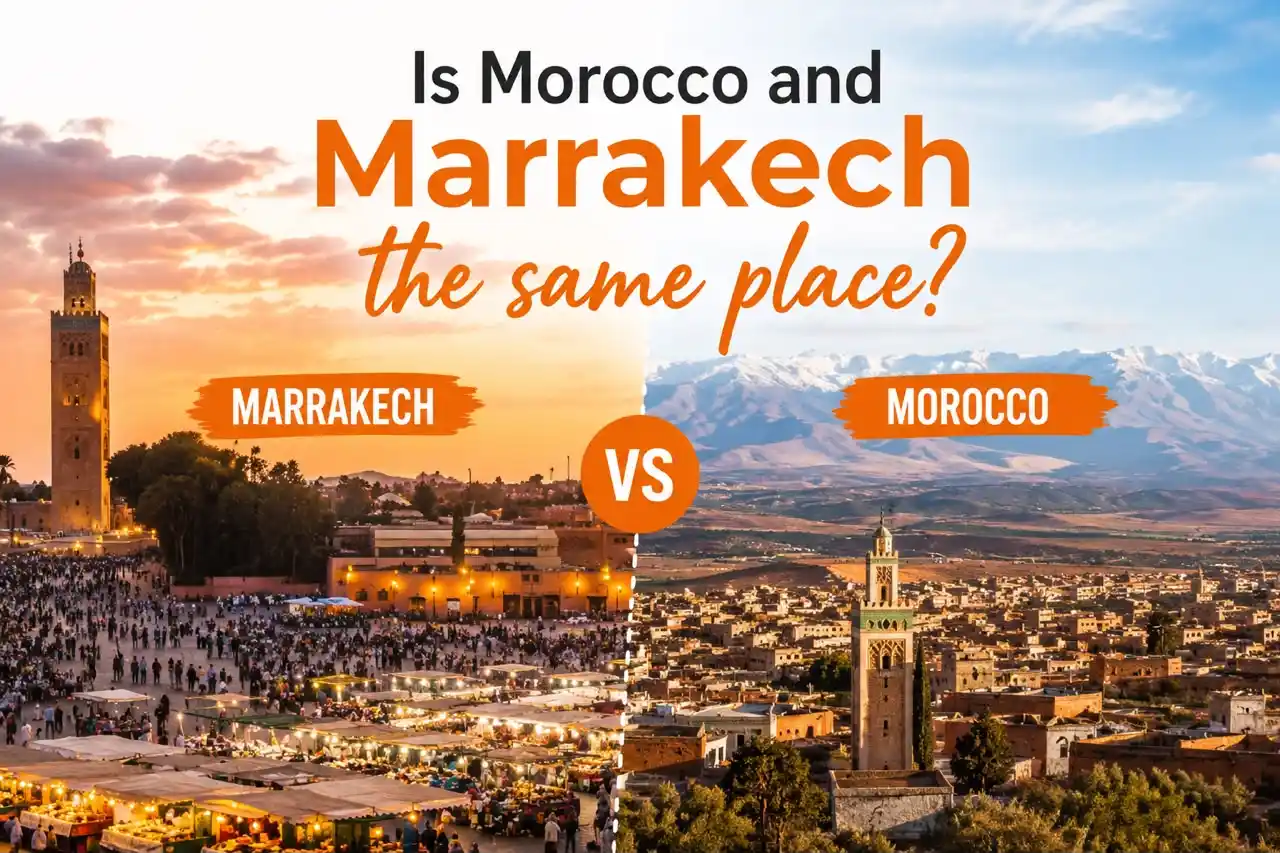
When planning a trip to North Africa, a surprisingly common point of confusion for first-time travelers is the question: Is Morocco and Marrakech the Same Place? Because the name of the city and the name of the nation sound so similar, and because Marrakech is world-famous as a major cultural hub, it is easy to see why people mix them up.
To put it simply, no, they are not the same thing. Morocco is a sovereign nation located in North Africa. Marrakech (often spelled Marrakesh), on the other hand, is an iconic city located within the country of Morocco. Thinking of them as interchangeable is like assuming New York is the entire United States or that Paris is the whole of France.
Understanding the distinction between the country as a whole and this famous city is the key to planning an authentic trip. While visiting Marrakech gives you a fantastic taste of vibrant local culture, the nation of Morocco extends far beyond its red clay walls to include dramatic coastlines, ancient imperial capitals, mountain ranges, and sweeping desert dunes.
To clearly answer Is Morocco and Marrakech the Same Place, it helps to look at how geography separates the whole country from just one of its major cities. Here is a simple breakdown:
Morocco is a Whole Country: It sits in the northwest corner of Africa, bordered by the Atlantic Ocean, the Mediterranean Sea, Algeria, and Mauritania. It is home to over 37 million people, diverse landscapes, and dozens of unique towns and cities.
Marrakech is a City Inside Morocco: Marrakech is located inland, in the southwestern-central part of the country, sitting just at the foot of the snow-capped High Atlas Mountains.
Size and Scale: Morocco covers over 440,000 square kilometers (about the size of California), while Marrakech is a single municipality covering roughly 230 square kilometers.
Where Marrakech Sits on the Map:
It is about 3 to 4 hours south of the coastal city of Casablanca.
It sits roughly 6 hours southwest of the cultural capital, Fes.
It acts as the main western gateway for travelers heading south toward the Sahara Desert.
Why Geography Matters: Assuming Marrakech represents the entire country means missing out on completely different geographic regions, such as the blue mountain villages of the north, the windy Atlantic surfing beaches, and the vast sand dunes of the south.
Understanding why people ask Is Morocco and Marrakech the Same Place requires taking a step back into history. The similarity between the two names is not a coincidence, they are directly connected through centuries of trade, ruling dynasties, and foreign languages.
The Medieval Capital: Marrakech was founded in the 11th century by the Almoravid dynasty. It quickly became the powerful political, economic, and cultural capital of the empire.
The Root Word Amurakush: The city’s name comes from the native Amazigh (Berber) phrase Amur n Akush, which roughly translates to “Land of God.”
Foreign Traders and Languages: Foreign merchants, sailors, and European diplomats who visited the region began calling the entire kingdom by the name of its dominant capital city.
Evolution into Spanish and English: In Spanish, the city’s name became Marruecos. Spanish traders used Marruecos to describe the whole nation, which eventually evolved into the English word Morocco.
Historical Foreign Terms: In several languages, such as Persian, Urdu, and Arabic dialects, the name for the entire country of Morocco was historically derived directly from the word Marrakech.
Global Fame and Branding: Because Marrakech is one of the most visited destinations in North Africa, its name frequently eclipses other regions in global travel marketing and popular culture.
The “Red City” Image: Many iconic photos associated with Moroccan tourism, like vibrant spice markets, clay arches, and lively public squares, come directly from Marrakech, leading travelers to assume the whole country looks identical.
While Marrakech gives travelers a fantastic glimpse into North African culture, assuming it represents the entire country overlooks the incredible diversity across Morocco’s regions. Asking Is Morocco and Marrakech the Same Place becomes even clearer when you look at how local life, food, pace, and traditions change from one town to the next.
Pace of Life & Atmosphere:
Marrakech: Fast-paced, high-energy, and deeply tourism-driven. The streets of the historic medina are filled with bustling souks, street performers, and continuous commerce.
The Rest of the Country: Varies dramatically. Coastal cities like Essaouira or Taghazout offer a slow, laid-back ocean lifestyle; northern mountain towns like Chefchaouen move at a calm, peaceful pace; and desert villages operate on a quiet, community-centered rhythm.
Architecture & Visual Aesthetics:
Marrakech: Famous for its iconic reddish-pink clay walls, earning it the nickname “The Red City,” with grand inner-courtyard riads and intricate carved plasterwork.
The Rest of the Country: Architectural styles shift by region. Fes features deep yellow sandstone and vibrant blue-and-green zellige tilework; Chefchaouen is washed entirely in shades of sky blue; and southern river valleys are built from towering mud-brick kasbahs.
Culinary Specialties & Regional Flavors:
Marrakech: World-renowned for Tanjia Marrakchia—a slow-cooked meat dish seasoned with preserved lemons, garlic, and cumin, baked in clay urns under the ashes of public bathhouses (hammams).
The Rest of the Country: Northern coastal areas specialize in fresh Atlantic fish tagines and seafood pastilla; the Middle Atlas region is known for hearty lamb tagines with prunes; and the Sahara region produces rich date harvests and distinct desert breads.
Languages & Local Dialects:
Marrakech: Darija (Moroccan Arabic) is widely spoken alongside French and English due to international tourism.
The Rest of the Country: Tachelhit (Amazigh) is spoken extensively in Marrakech and the High Atlas, whereas Tamazight and Tarifit dominate the central and northern mountain ranges. In northern cities like Tangier or Tetouan, Spanish is far more commonly spoken than English.
To fully appreciate why asking Is Morocco and Marrakech the Same Place is an important distinction, you have to look at the country’s historic “Imperial Cities.” Throughout history, four major cities served as the political seat of power for different ruling dynasties. While Marrakech is arguably the most famous, each imperial city has its own distinct personality, architectural style, and historical legacy.
Current Seat of Government: While many assume Marrakech is the nation’s capital, Rabat holds that official title and serves as the primary residence of the King.
Refined Coastal Atmosphere: Rabat blends wide, tree-lined modern boulevards with historic treasures like the 12th-century Hassan Tower and the whitewashed Kasbah of the Udayas overlooking the ocean.
Quieter Tourism: Unlike the high-energy, tourist-dense streets of Marrakech, Rabat offers a calm, polished, and laid-back urban experience.
Grand Sultanate Legacy: Built in the 17th century by Sultan Moulay Ismail, Meknes was designed to rival the grand European courts of its era.
Monumental Architecture: Home to Bab Mansour, one of the most magnificent and intricately tiled imperial gates in all of North Africa.
Gateway to Ancient History: Located just a short drive from Volubilis, the best-preserved ancient Roman ruins in Morocco.


If you only visit the “Red City,” you miss out on the incredible geographic variety that defines the rest of the nation. Answering Is Morocco and Marrakech the Same Place becomes unmistakable when you look at the dramatic shifts in terrain across the country:
The High Atlas & Rif Mountains: Just a short drive south of Marrakech lies the High Atlas range, featuring snow-capped peaks like Mount Toubkal (4,167 m) and alpine valleys like Imlil. To the north, the Rif Mountains offer lush green pine forests and dramatic limestone cliffs around Chefchaouen and Akchour.
The Saharan Dune Seas: Traveling southeast toward Merzouga or M’Hamid brings you to the edge of the vast Sahara Desert. Regions like Erg Chebbi feature towering golden sand dunes that reach up to 150 meters high, a completely different world from the bustling urban gardens of Marrakech.
Coastal Plains & Windy Atlantic Bays: Along the western edge of the country, towns like Essaouira, Taghazout, and Oualidia offer Atlantic sea breezes, dramatic coastal cliffs, estuaries, and long sandy beaches popular for surfing and seafood harvesting.
Lush River Valleys & Date Palm Oases: Corridors like the Draa Valley and Ziz Valley stretch for miles filled with date palms, irrigated farmland, and deep limestone gorges (such as Todra and Dades) carved out by rushing mountain rivers.
Understanding that Is Morocco and Marrakech the Same Place is more than just a quick trivia fact, it is the key to building a realistic and rewarding travel schedule. Because the nation offers so much visual and geographic variety beyond its most famous city, how you structure your time makes all the difference.
How Many Days to Spend in Marrakech vs. Rest of the Country:
2 to 3 Days in Marrakech: Perfect for exploring the major highlights, including the iconic Jemaa el-Fnaa square, Bahai Palace, Saadian Tombs, and wandering the central souks.
7 to 10 Days total for Morocco: Gives you enough time to combine Marrakech with a 3-day Sahara Desert loop (via Aït Ben Haddou and Ouarzazate) plus a coastal trip to Essaouira.
14 Days or More: Allows you to build a complete country-wide circuit, connecting Marrakech, Fes, Chefchaouen, Rabat, and the High Atlas Mountains smoothly.
Best Transportation Options Between Regions:
High-Speed Rail (Al Boraq): Connects northern coastal hubs like Tangier to Rabat and Casablanca in record time, offering clean, modern, and high-speed travel.
ONCF Trains & Supratours Buses: Reliable train networks connect major cities, while comfortable, long-distance buses reach inland towns like Chefchaouen and coastal hubs like Essaouira.
Private Drivers & Guided Tours: Ideal for navigating mountain passes, desert routes, and ancient kasbahs in the south where public transit schedules are less flexible.
Key Mistakes First-Time Visitors Should Avoid:
Trying to See Everything from One Base: Staying only in Marrakech and attempting long day trips every day leads to travel fatigue. It is much better to stay overnight in different regions.
Underestimating Driving Distances: The Atlas Mountains feature winding roads where short map distances take much longer to drive than expected.
Skipping the Northern & Coastal Regions: Don’t limit your trip to just the southern desert route, the northern mountain villages and Atlantic harbors offer completely different cultural atmospheres.
To answer the core question once and for all: Is Morocco and Marrakech the Same Place? Absolutely not. While Marrakech serves as an essential cultural gateway, filled with historic clay palaces, bustling markets, and world-class hospitality, it represents just one vibrant chapter of a much larger story.
Equating the city of Marrakech with the entire nation of Morocco means overlooking an incredible spectrum of landscapes, traditions, and regional cultures. Beyond the iconic red walls of the city lie snow-capped mountain peaks, tranquil Atlantic surfing harbors, ancient Roman ruins, and towering Saharan dunes.
When planning your journey, treat Marrakech as a jumping-off point rather than your sole destination. By combining time in the “Red City” with explorations across the surrounding valleys, coastal retreats, and historic medinas, you will experience the full depth and beauty that the Kingdom has to offer.
Understanding this key distinction is the secret to unlocking an authentic, well-rounded trip. Embrace the unique energy of Marrakech, but make sure to step beyond its borders to discover why the country as a whole remains one of the world’s most captivating travel destinations.
To Marrakech Desert Tours is a professional team dedicated to showing you the very best of the Moroccan desert. We offer high-quality tours with expertly designed programs to give you an unforgettable experience.
ToMarrakechDesertTours.com is a group of local experts who love sharing the authentic beauty of Morocco.
Our services are tailored for everyone, offering amazing adventures that fit any budget perfectly.
⇢ Booking directly with a local team saves you time, money, and stress, and makes sure every part of your trip is well organized.
⇢ Our guides and drivers are passionate about Morocco and love sharing its culture, history, and landscapes with our guests.
⇢ Every tour is private and flexible, so we can adapt the route, the pace, and the activities to your wishes.
© 2026 TO MARRAKECH DESERT TOURS. ALL RIGHTS RESERVED.