- tomarrakechdeserttours@gmail.com
- +212702431727

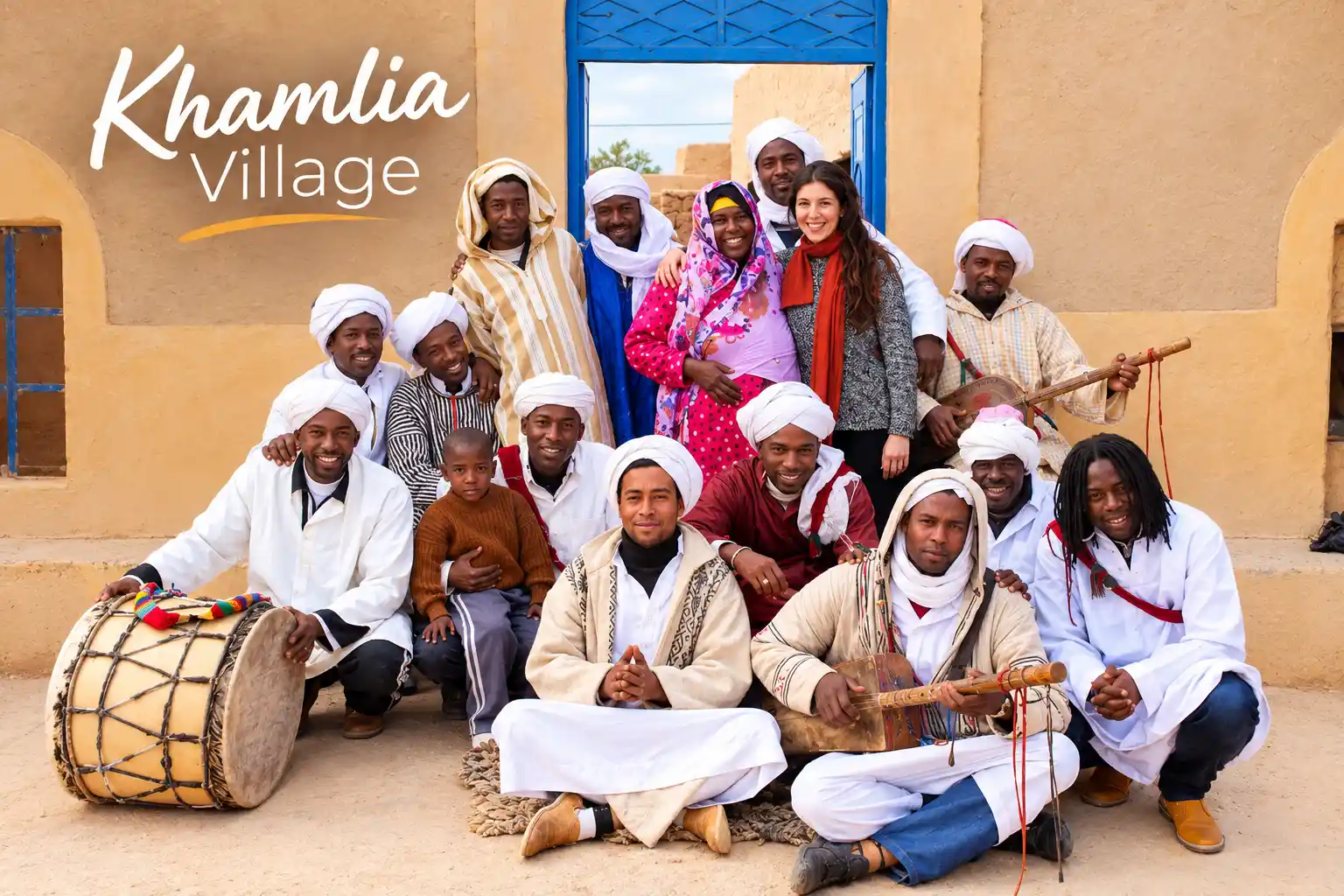
Many travelers come to Merzouga for the big golden dunes, but fewer people know about a small village just a short drive away where music is part of everyday life. Khamlia Village, sometimes written Khamliya, sits at the edge of the Sahara and is famous for its warm welcome and its powerful drum music.
In this guide, we explain what Khamlia Village is, who lives there, what you can see and hear, how to visit, and how to be a respectful guest. Whether you are planning a quick stop during a 4×4 excursion or a longer trip in the desert, this guide will help you enjoy it.
Let’s discover Khamlia Village!
Khamlia Village is a small village in southeastern Morocco, about 8 to 10 kilometers from Merzouga, close to the foot of the Erg Chebbi dunes. You may see the name written in different ways, such as Khamlia, Khamliya, or Khamlya, but they all mean the same place.
The village is quiet and simple, with low earth-colored houses, dusty streets, and open desert all around. There are no big hotels or busy markets. This is exactly what makes it interesting: it feels like real desert life, not a tourist show.
Khamlia Village is often described as a Gnawa community. Many families here are descendants of people who came from sub-Saharan Africa centuries ago, during the time of the old trans-Saharan trade routes. Over the years, they built their own life in the desert and kept strong traditions, especially in music, dance, and spiritual customs.
Today, the village is a place where different cultural roots meet. Arabic, Berber, and African influences live side by side, and this mix is easy to hear in the songs and rhythms. For visitors, this history adds a lot of meaning to a short visit.
The main reason many travelers visit Khamlia Village is the music. Gnawa music is deep, rhythmic, and a little hypnotic. Musicians play large drums, metal castanets known as qraqeb, and other traditional instruments, while singers repeat strong, simple phrases that build slowly in energy.
The sound is very different from what most visitors expect. It is not background music, it is a shared experience. Some songs are calm and slow, and others are fast and powerful, often with dancing. Even if you do not understand the words, the rhythm is easy to feel.
A visit to Khamlia Village usually includes a short music performance in a local home or small venue. You sit with other guests, often with a glass of mint tea, while the musicians play for 15 to 30 minutes. Sometimes you are invited to clap along, or even to try the castanets.
It is not a big show with lights and a stage. It is more like being welcomed into a living room where music happens. This simple style is part of the charm.
Remember that this is not just entertainment for the villagers, it is part of their culture. Listen with respect, and ask before filming or taking close-up photos of people.
The village is close enough to reach in a short drive. Most travelers visit as part of a 4×4 desert excursion or a quad tour, often combined with other stops. You can also ask your hotel or guesthouse to arrange a transfer.
If you are on a classic Sahara trip, Khamlia Village is easy to add to your plan, especially during a full-day desert excursion. It is also a good choice if you want to see more than just the dunes.
The area around Khamlia Village is full of interesting places, so it is easy to turn a short visit into a half-day or full-day trip.
Like the rest of Merzouga, the best seasons for visiting Khamlia Village are spring, from March to May, and autumn, from September to November. Days are warm, evenings are pleasant, and the desert is comfortable for walking and riding.
Summer can be very hot, so it is best to visit early in the morning or late in the afternoon. Winter days are mild, but nights can be cold, especially if you plan to stay in a desert camp afterward.
Khamlia Village is a real community, not a theme park. A few simple habits help you enjoy your visit and leave a good impression.
Small acts of respect make a big difference, and most villagers will be happy to share their culture with kind and curious visitors.
If you only have a few hours, here is an easy plan that includes Khamlia Village without feeling rushed.
If you have more time, you can turn this into a full-day trip with lunch in the desert and additional stops.
Khamlia Village shows a side of the Sahara that many travelers miss. Beyond the dunes and the camels, there is a living community with deep roots, powerful music, and a very friendly spirit. A short stop here can add real meaning to your Merzouga trip.
With a little respect, a bit of curiosity, and good timing, you can enjoy a performance, learn about local life, and take home a memory that feels personal and genuine.
At To Marrakech Desert Tours, we love adding stops like Khamlia Village to our desert excursions, so travelers can enjoy both the beauty of the dunes and the culture of the people who call this place home. Let us help you plan your Merzouga adventure.
To Marrakech Desert Tours is a professional team dedicated to showing you the very best of the Moroccan desert. We offer high-quality tours with expertly designed programs to give you an unforgettable experience.
ToMarrakechDesertTours.com is a group of local experts who love sharing the authentic beauty of Morocco.
Our services are tailored for everyone, offering amazing adventures that fit any budget perfectly.
⇢ Booking directly with a local team saves you time, money, and stress, and makes sure every part of your trip is well organized.
⇢ Our guides and drivers are passionate about Morocco and love sharing its culture, history, and landscapes with our guests.
⇢ Every tour is private and flexible, so we can adapt the route, the pace, and the activities to your wishes.
© 2026 TO MARRAKECH DESERT TOURS. ALL RIGHTS RESERVED.