
Madrasa Ben Youssef Marrakech: History, Architecture & Visitor Guide
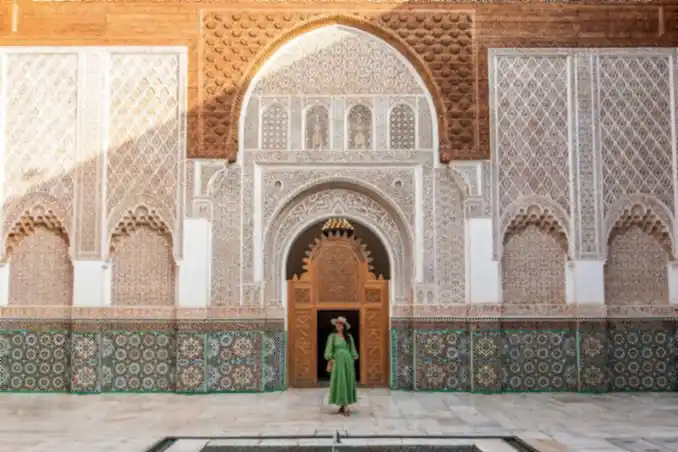
Step through a small door in the medina and suddenly the noise of the souks disappears. In front of you is a calm courtyard, a long pool of water and walls covered with carved cedar, white stucco lace and colorful zellij tiles. Welcome to the Madrasa Ben Youssef Marrakech, one of the most beautiful buildings in Morocco and a highlight of any visit to the Red City.
As a local travel company in Morocco, we take many travelers here every year, and the reaction is always the same: wow. In this guide we explain the history and the architecture of the madrasa, and we share practical tips to help you enjoy your visit.
The Madrasa Ben Youssef Marrakech is a former Islamic college in the heart of the medina. The current building was completed in 1564–65 under the Saadian sultan Abdallah al-Ghalib. It has 130 student rooms, a large courtyard with a pool, and some of the finest zellij, stucco and cedar wood carving in Morocco. Today it is a historic monument open to visitors.
Table of Contents: Madrasa Ben Youssef Marrakech
What Is the Madrasa Ben Youssef Marrakech?
A madrasa is a traditional school where students learned the Quran, Islamic law, theology, grammar and sciences. Students lived in small rooms around the courtyard and studied in the prayer hall and the nearby mosque. The Madrasa Ben Youssef Marrakech takes its name from the Ben Youssef Mosque next door, which was founded by the Almoravid sultan Ali ibn Yusuf in the 12th century.
At its height, it was the largest madrasa in Morocco and one of the most important centers of learning in North Africa. Today there are no more students, but the building has been carefully restored and welcomes visitors from all over the world.
History of the Madrasa Ben Youssef Marrakech
The story of the Madrasa Ben Youssef Marrakech covers more than six centuries. Here are the key dates:
14th century: the first madrasa
The first madrasa on this site was founded during the Marinid dynasty by Sultan Abu al-Hasan, a ruler famous for building schools in several Moroccan cities.
1564–65: the Saadian rebuilding
The Saadian sultan Abdallah al-Ghalib built the madrasa we see today. The Saadians made Marrakech their capital again and filled it with beautiful monuments.
A great center of learning
For centuries, students from across Morocco came here to study. The building was described as the largest Islamic college in the Maghreb.
1960: the school closes
The madrasa stopped working as a school in 1960, when modern education took its place.
1982: open to the public
After restoration, the building reopened as a historic site so visitors could admire its art and architecture.
2018–2022: a major restoration
The madrasa closed in 2018 for a large restoration and reopened in 2022, with renewed wood, plaster and tiles that shine like new.
Architecture of the Madrasa Ben Youssef Marrakech
The Madrasa Ben Youssef Marrakech is a masterpiece of Moroccan and Andalusian art. Every surface is decorated, but the overall feeling is one of harmony and peace. Look out for these details:
The entrance passage
A narrow corridor leads from the street into the madrasa. The street entrance has a muqarnas (honeycomb) vault and bronze-plated doors, a first taste of the beauty inside.
The courtyard and pool
The heart of the building is a large marble courtyard with a long, shallow pool in the middle. The water reflects the walls and the sky and creates a calm atmosphere.
Zellij tiles
The lower walls are covered with zellij, small pieces of glazed tile cut by hand and arranged in complex geometric stars and patterns.
Carved stucco
Above the tiles, white and cream plaster is carved like lace, with floral designs, geometric shapes and Arabic calligraphy.
Cedar wood
The upper walls, the eaves and the doors are made of carved cedar wood from the Atlas Mountains, with a warm color and a pleasant smell.
The prayer hall
At the end of the courtyard is the prayer hall, where the mihrab (prayer niche) is decorated with some of the richest stucco work in the building.
The student rooms
Around six small inner courtyards, two floors of tiny rooms housed the students. There are 130 rooms in total, simple and small, with windows over the courtyards.
Daily Life of the Students
Imagine life in the Madrasa Ben Youssef Marrakech a few centuries ago. Young men arrived from towns and villages across Morocco, often with very little money. They lived in tiny rooms, sometimes shared by two or three students, with a simple mat to sleep on and a small window over the courtyard. The rooms were cold in winter and hot in summer, but students did not come for comfort: they came for knowledge.
The day started before sunrise with prayer, followed by long hours of study. Students memorized the Quran, read classical books and listened to teachers in the prayer hall and the mosque next door. Food was simple and often given by the community or the mosque. Many of these students later became teachers, judges and scholars in their own towns, carrying the knowledge of Marrakech across the country.
Other Famous Madrasas in Morocco
If you fall in love with the Madrasa Ben Youssef Marrakech, you can visit other beautiful madrasas during your trip. Most of them date from the Marinid period and share the same style of tiles, stucco and cedar wood:
| Madrasa | City | Highlights |
|---|---|---|
| Bou Inania Madrasa | Fes | Built in the 14th century, with a rare minaret and a famous water clock facing the entrance |
| Al-Attarine Madrasa | Fes | A small jewel near the Spice Market, with very fine decoration |
| Marinid Madrasa | Salé | A quiet madrasa near the Great Mosque, with a terrace view over Rabat |
| Bou Inania Madrasa | Meknes | An elegant courtyard and a rooftop with views of the old city |
Our tours from Marrakech to Fes, such as the 3 days desert tour from Marrakech to Fes, are a great way to combine the madrasas of both imperial cities with a night in the Sahara.
Visiting the Madrasa Ben Youssef Marrakech: Practical Tips
Here is what you need to know before visiting the Madrasa Ben Youssef Marrakech:
- Location: in the north of the medina, next to the Ben Youssef Mosque and the Marrakech Museum, about a 15-minute walk from Jemaa el-Fna through the souks.
- Opening hours: the madrasa usually opens every day from morning until early evening. Hours can change during Ramadan and holidays, so check the official Madrasa Ben Youssef website before you go.
- Tickets: you can buy them at the entrance or online on the official website. Children and students may have reduced rates.
- Time needed: plan 45 minutes to 1 hour 30 minutes to see the courtyard, the prayer hall and the student rooms.
- Best time to visit: come early in the morning or late in the afternoon to avoid the groups and enjoy soft light for photos.
- Dress code: there is no strict rule, but clothes that cover shoulders and knees are respectful in this historic religious place.
- Accessibility: the courtyard is on one level, but the student rooms upstairs are reached by narrow stairs.
Best Season to Visit
You can visit the Madrasa Ben Youssef Marrakech all year, because most of the visit is in the shade of the courtyard and the corridors. Spring (March to May) and autumn (September to November) are the most pleasant seasons to explore the medina on foot. In summer, visit early in the morning before the heat, and in winter enjoy the quiet mornings and the soft light on the carved walls. Read our guide to the best time to go to Morocco for more details.
Photography Tips
The Madrasa Ben Youssef Marrakech is one of the most photographed places in Morocco. To get the best pictures, stand at the end of the pool to capture the reflection of the prayer hall entrance, look up to photograph the carved cedar and stucco, and climb to the upper floor for a view over the courtyard from the small windows of the student rooms. A wide-angle lens or the wide mode of your phone helps a lot. Please be patient and respectful with other visitors when the courtyard is busy.
What to See Near the Madrasa Ben Youssef
The area around the Madrasa Ben Youssef Marrakech is full of history. Combine your visit with these nearby places:
| Place | Why visit |
|---|---|
| Marrakech Museum (Dar Menebhi) | A 19th-century palace with a beautiful covered courtyard and art exhibitions |
| Almoravid Koubba | One of the oldest buildings in Marrakech, from the 12th century |
| Le Jardin Secret | A restored riad garden with Islamic and exotic plants and a tower with a view |
| The souks | Lanes of craftsmen selling leather, lamps, spices, carpets and jewelry |
| Jemaa el-Fna | The famous main square, full of life in the evening |
Note that the Ben Youssef Mosque itself is only open to Muslims, but you can admire its minaret from the street.
Visit with a Local Guide
The Madrasa Ben Youssef Marrakech is beautiful on its own, but a good guide brings it to life. A local guide explains the meaning of the calligraphy, the daily life of the students and the history of the Saadian dynasty, and helps you find your way through the medina without getting lost.
Book our Marrakech city tour with a guide to visit the madrasa together with the palaces, the souks and Jemaa el-Fna. For more ideas, read our list of the best activities to do in Marrakech and our 3 day Marrakech itinerary.
Add the Desert or the Mountains to Your Trip
After exploring the medina, many travelers want to see the other faces of Morocco. Discover our day trips from Marrakech to the Atlas Mountains, the Ourika Valley or Essaouira, or join one of our Marrakech desert tours to sleep under the stars in the Sahara. And don’t forget to taste the best food in Morocco during your stay.
Frequently Asked Questions
What is the Madrasa Ben Youssef Marrakech?
It is a former Islamic school in the medina of Marrakech, completed in 1564–65 by the Saadian sultan Abdallah al-Ghalib. It is now a historic monument famous for its architecture.
How old is the Madrasa Ben Youssef?
The first madrasa on the site dates from the 14th century, and the current building is more than 450 years old.
How long does a visit take?
Most visitors spend between 45 minutes and 1 hour 30 minutes inside.
Is the Madrasa Ben Youssef Marrakech open every day?
It is usually open every day. Hours can change during Ramadan and holidays, so check the official website before your visit.
Can non-Muslims visit the madrasa?
Yes. The madrasa is open to all visitors. Only the Ben Youssef Mosque next door is reserved for Muslims.
Do I need a guide?
No, you can visit alone, but a local guide helps you understand the history and the details of the decoration.
Conclusion
With its peaceful courtyard, shining zellij, lace-like stucco and warm cedar wood, the Madrasa Ben Youssef Marrakech is a perfect example of the art and history of Morocco. Whether you love architecture, photography or simply beautiful places, it deserves a place on your Marrakech itinerary.
Want to discover the madrasa and the rest of the Red City with a local expert? Contact us today for your free quote, and let our team plan your perfect trip in Marrakech and beyond.
contact us
Click any destination below to preview the complete itinerary
- 2 Days Desert Tour from Marrakech to Merzouga
- 2 Days Desert Tour from Marrakech to Fes
- 3 Days Desert Tour from Marrakech to Merzouga
- 3 Days Desert Tour from Marrakech to Fes
- 4 Days Desert Tour from Marrakech to Merzouga
- 5 Days Desert Tour from Marrakech to Merzouga
- 5 Days Sahara Desert Tour from Marrakech
- 6 Days Desert Tour from Marrakech to Csablanca
- 7 Days Desert Tour from Marrakech to Casablanca
- 8 Days Morocco Tour From Marrakech
- 10 Days Morocco Tour From Marrakech
- 12 Days Morocco Tour From Marrakech